Ad Affiliate buying guide.
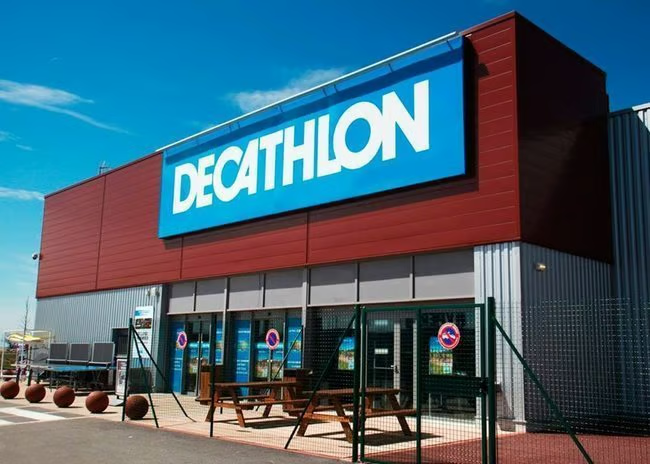
Decathlon UK · Sport, on your terms
A place for the sport you actually want to do.
My idea of an active life has room for different moods: a swim after work, a little time outdoors, or a new activity that makes an ordinary week more interesting.
That is what draws me to Decathlon UK. The appeal is a sports-shopping destination that lets me explore those possibilities, then choose the equipment that fits my time, budget and level of interest.

Why the brand belongs on my shopping shortlist
Decathlon UK fits a life with more than one interest
There is a gap between the polished version of sport and the way it fits into a normal diary. I am more interested in making room for something enjoyable than in announcing a complete lifestyle transformation. A retailer becomes useful when it helps turn that modest intention into a practical next step.
Decathlon’s UK site gives me that starting point through its sport-led browsing. Running, swimming, fitness, cycling, hiking and camping sit alongside interests such as football and golf. It also has men’s, women’s and children’s sections. The significance is not simply a long menu: different people, and different parts of the same week, can begin in the same place.
For someone returning to an old hobby, the task might be replacing one missing essential. For a household with several interests, it might be comparing needs across a gym session, a school activity and a weekend outdoors. For a curious beginner, it might be finding out what an unfamiliar sport actually involves before building a basket.
That flexibility is the reason I want to explore the brand as a whole. I can start with the activity, rather than allowing one attractive product to decide the activity for me.
There is more behind the range than one name on a label
One of the more useful things to understand about Decathlon is that it is not simply a shop gathering other companies’ products. Its own account of the business describes in-house design and development around individual sports.
The current UK range includes names such as Quechua for hiking and camping, Kiprun for running, Domyos for fitness and Nabaiji for swimming. I find that a helpful way to make sense of the assortment: one retailer, with ranges organised around different activities.

A sports range is most interesting to me when it explains the job its equipment is designed to do. For outdoor kit, that means considering the intended conditions. For clothing, fit and freedom of movement matter. For equipment, compatibility and the space available at home can be decisive.
Those questions keep the browsing grounded. I want useful information about the activity, not just a familiar logo or a dramatic product photograph.
There is an important distinction here: the website also carries other brands and marketplace offers. The brand printed on an item is not the same thing as the seller handling the order. I check the “sold and shipped by” information before assuming that delivery or returns will work the same way across the whole site.
The useful choice is the one that matches your stage
A large sports shop can be inspiring, but it can also make a small decision feel unnecessarily complicated. My way through the range is to decide what stage I am at before comparing features.
A new interest
Make the first step approachable
If I am exploring an activity, I look for the essentials that help me participate comfortably and appropriately. Clear intended-use information is more useful than automatically choosing the most elaborate option.
The point is to give the interest a fair chance, with a purchase that makes sense for the sessions I am realistically planning.
An established routine
Spend on a problem you recognise
Once an activity is part of the week, the brief becomes more precise. Perhaps fit is the issue, a feature has become important, or existing equipment no longer suits the way it is used.
That is when a more detailed comparison earns its time: the extra spend needs to answer an actual requirement.
The advantage of starting from Decathlon’s homepage is that I can choose my own route through the shop. Someone looking for a regular training activity can begin in one sport; someone planning for several people can move between interests. The brand is the starting point, not a prescription for one particular shopping list.
Value is about making participation easier
Decathlon presents accessible sport as central to its approach. My measure of that promise is practical: can I find something that suits the activity and the amount I want to spend? Comfort, intended use and features I will actually use matter more to me than an impressive-looking specification.
I also include the less obvious costs in the decision: delivery, any necessary accessories and the care an item needs. Looking at the whole purchase makes the brand’s range more useful than chasing the lowest headline price alone.
The best sports-shopping destination helps you picture the next session, not just the next purchase.
A good shopping plan includes the practical details
The most convincing range still has to fit around everyday logistics. Before placing an order, these are the details I want to settle.
- How will it reach me? Decathlon UK offers delivery and Click & Collect options, subject to the order and location. I check the actual cost and estimated date, and wait for a collection confirmation rather than assuming every item is ready locally.
- Who handles the order? Check the seller and fulfilment information. Marketplace products can have different delivery arrangements and return conditions, even though the shopping begins on the same website.
- What happens if the fit is wrong? Eligible purchases linked to Decathlon membership can have up to 365 days for unwanted-item returns; non-members generally have 30 days. Items must be unused, clean and in their original packaging, subject to conditions and exclusions. Marketplace returns have seller-specific conditions.
These checks do not take the enjoyment out of browsing. They make it easier to turn a promising choice into an order that fits the week, especially when timing or trying the fit matters.
The brand story can continue after the basket
I also pay attention to the parts of a retailer’s site that are not about buying something new. Decathlon UK’s repair offering includes workshop support, repair guidance and ways to look for suitable spare parts. What is available depends on the product and service, so I would check the exact support rather than assume every item can be repaired locally.
Its Second Life section offers checked second-hand equipment with condition information. That creates another route worth exploring when the right item is available; check the particular listing’s stock, condition and warranty details.
For me, these services add substance to the brand proposition. They provide useful places to investigate caring for equipment or choosing a replacement as needs change. It is a broader relationship with sport than simply buying the next new thing.
Why I would start with Decathlon UK
Decathlon UK is an appealing place to begin if you are curious about a new sport, returning to an old one, or shopping around several interests in the household. Its sport-led range gives the browsing a direction; its mix of product choices and services gives the decision more than one dimension.
My route through the website is straightforward: choose the sport, compare options for the way I plan to participate, then check fit and the order details. As an interest develops, the same destination has other ranges and support to explore.
What I like most about the idea is its everyday scale. Sport can be the hour between work and dinner, a shared weekend plan, or an interest that gradually becomes a habit. My reason to explore Decathlon is to find the practical support for that life, with room to decide what comes next.
Your next activity can start here.
Explore the brand, choose the sport that interests you, and compare the options that fit your plans. There is more than one way to make the week a little more active.